
Return
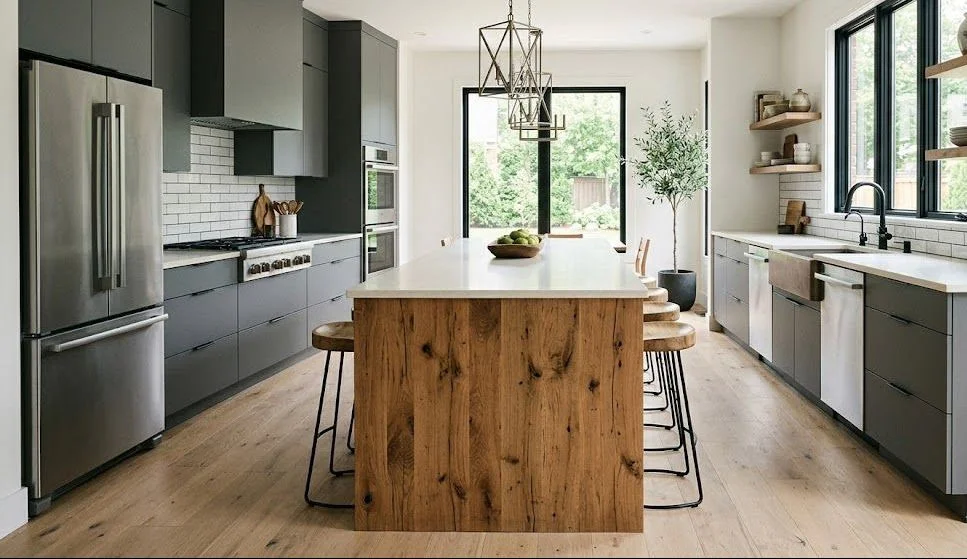
Here’s Why Hardwood (and Alder) Still Matters
Thermally Fused Laminate (TFL) is gaining share in cabinets, and it’s a real competitor. It shows up most in value-engineered jobs and high-volume production because it delivers speed, uniformity, and predictable cost. For hardwood manufacturers and distributors, that shift is impossible to miss. The right response isn’t to dismiss TFL or pretend it’s a fad; it’s to understand where it fits, communicate where it falls short, and keep making the strongest case for real hardwood, especially species like Alder that pair performance with a compelling sustainability story.
Why TFL is winning share. TFL is a factory-finished decorative surface fused to a composite core (commonly particleboard or MDF). In many shops, that translates into fewer finishing steps, repeatable results, and a clean, contemporary look that stays consistent from sheet to sheet. Design teams also like the wide range of “wood-look” and solid-color options and the ability to specify the same finish across multiple components. When budgets are tight or timelines are compressed, those advantages can be decisive.
It’s also fair to say TFL has improved. Better print resolution, deeper textures, and lower-sheen options can make panels look more convincing than older generations of laminates. In the right setting, particularly flat slab doors, modern cabinetry, and utility-driven applications. TFL can deliver a tidy, durable surface at a price point that expands access to new kitchens, closets, and commercial fixtures.
Where hardwood still outperforms. The most important differentiator is that hardwood is not a thin decorative layer, it’s the material all the way through. That matters in real-world shops and real homes. Hardwood can be sanded, repaired, and refinished. When a chair scrapes a toe-kick, when a sink leaks, or when a corner gets chipped during installation, a hardwood surface often has a second life. With TFL, damage frequently breaks the surface and exposes the core, which can mean touch-up limitations or outright replacement of the component.
Hardwood also delivers something that’s hard to replicate: depth and character. Natural variation, chatoyance, and grain movement are not “defects” they are the features customers associate with craftsmanship and authenticity. And unlike printed surfaces that stay visually static, hardwood develops a lived-in patina. In many mid- to high-end projects, that emotional value is part of what the buyer is paying for, and it’s why real wood remains the reference point for “warmth” in interior design.
Why Alder deserves special attention. Alder is often described as the “workhorse” hardwood for cabinetry and millwork because it machines cleanly, takes stain and paint well, and offers a consistent, friendly color palette that works across styles. It’s also versatile: it can support contemporary looks when finished clean and uniform, or it can lean rustic with character grades that show more natural features. For manufacturers, that flexibility helps serve multiple customer segments without reinventing the entire raw material strategy.
Alder’s sustainability story (and hardwood as a carbon store). If sustainability is part of the buying decision, and it increasingly is, Alder gives hardwood a strong, credible message. One reason is its fast-growing nature and ready regeneration, which means it can capture carbon rapidly as it grows. Then, when the log becomes lumber and that lumber becomes a long-lived product, the carbon remains stored in the wood for the life of the cabinet, furniture piece, or architectural interior. The longer the service life, the longer that biogenic carbon stays out of the atmosphere. This is why durability, repairability, and the ability to refinish are more than quality features, they’re sustainability features, too.
Lifecycle tradeoffs to keep in mind with TFL. This isn’t an argument that TFL is “bad” or that panels can’t be part of a responsible supply chain. Composite cores may incorporate recovered wood fiber, and panel optimization can reduce waste in certain layouts. But TFL is typically a layered product: a composite core plus resin-impregnated decorative papers fused under industrial heat and pressure. Those inputs and processes generally carry a different manufacturing footprint than sawn lumber, and the reliance on synthetic resins introduces its own considerations (including emissions requirements and compliance constraints depending on the market).
End-of-life is also part of the lifecycle equation. Solid hardwood components are easier to reuse, repair, and in some cases re-mill or repurpose. A layered composite surface is harder to renew once it’s damaged, and it’s more difficult to separate into clean material streams. Practically speaking, that can shorten the useful life of certain components or increase replacement rates in applications that see hard wear. The most sustainable material is often the one that lasts longest in the real world, especially when it can be renewed rather than discarded.
How to compete without pretending TFL doesn’t exist. The strongest hardwood message is clear and practical: specify hardwood where authenticity, repairability, and long-term value are priorities, and use panels strategically where uniformity and price point rule the decision. When hardwood is the right answer, say why in plain language, real wood feel, real wood depth, service life, and the ability to refinish. And when you feature Alder, connect the dots: it performs in the shop, it looks great in a wide range of finishes, it grows quickly, and it stores carbon when it becomes a long-lived product.
Bottom line: TFL is a meaningful competitor and will continue to take share in certain cabinet categories. But hardwood (especially Alder) still offers advantages that engineered surfaces can’t fully replicate: renewability through refinishing, authentic character, and carbon stored in solid wood over a long service life. If we keep the conversation grounded in performance and lifecycle reality, hardwood remains an easy material to defend…and a smart one to specify.
