
Pacific Coast Bigleaf Maple
Jan 28, 2026
Return
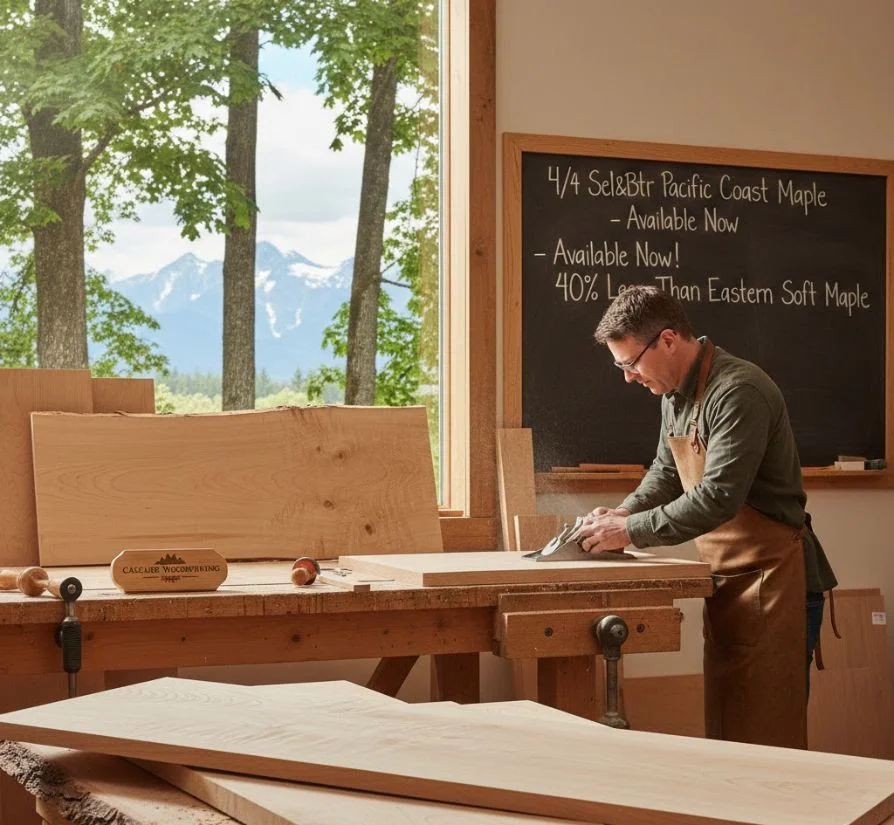
A Great Value Choice for Quality Woodworking
When comparing Pacific Coast Bigleaf Maple (Acer macrophyllum) to its Eastern counterparts, Red Maple (Acer rubrum) and Silver Maple (Acer saccharinum), Bigleaf stands out as a versatile, high-value hardwood ideal for premium applications. Native to the coastal Pacific Northwest, Pacific Coast Maple thrives in Cascade’s unique ecosystem, producing wood that’s lighter and more workable, with a density similar to Eastern
What is surprising is that we now have inventory for prompt available to ship in 4/4 Sel&Btr Pacific Coast (Bigleaf) Maple, whereas Sel&Btr Eastern Soft Maple seems to be in short supply. In last week’s Hardwood Market Report, they noted, “One trend consistently noted among contacts is solid demand for the upper grades” when discussing Eastern Soft Maple. Even more surprising is that we have 6 loads ready to go despite the price being up to 40% less expensive FOB mill than Unselected Eastern Soft Maple. While the Pacific Coast Maple is not as bright white as its Eastern counterparts, it has little or no differentiation between heartwood and sapwood. Western Maple also exhibits a little more stress; yet it represents a great value for anyone needing 4/4 Sel&Btr Soft Maple.
In terms of density, Pacific Coast Maple averages 34 lbs/ft³, lighter than Red Maple’s 38 lbs/ft³ and Silver Maple’s similar range, making it easier to handle without sacrificing durability. Its Janka hardness of 850 lbf strikes a perfect balance; it is harder than Silver’s 700 lbf for better wear resistance, yet softer than Red’s 950 lbf, reducing tool wear and burning during machining.
Workability shines with Pacific Coast Maple: it turns, glues, and finishes exceptionally well, with fewer blotches during staining than Eastern maples. Its sapwood-dominant use yields a nearly white to light tone, perfect for figured patterns like curly or quilted grains, which command premium prices. While all are soft maples (vs. hard maple’s 1,450 lbf), Pacific Coast’s slower growth in old-growth forests results in denser, more characterful wood. Sustainability also favors Pacific Coast Maple; it is not listed as threatened, and there are abundant timber supplies. For Cascade customers, choosing Pacific Coast Maple means investing in superior aesthetics, ease of use, and regional pride over Eastern alternatives.
A couple of applications that trend well with Pacific
