
Consolidation Wave in Housing and Building Products
Jun 30, 2026
Return
What It Means for Alder Hardwood Use in New Construction
At Cascade Hardwood, we have long championed the beauty and versatility of Pacific Northwest Alder. Its warm tones, consistent grain, and superior workability make it a favorite for cabinetry, moulding, and custom trim. Yet the latest wave of mergers and acquisitions across homebuilding, manufacturing, and distribution is reshaping the landscape in ways that could challenge the diversity and choice that define quality hardwood projects.
Berkshire Hathaway’s $8.5 billion acquisition of homebuilder Taylor Morrison signals big capital doubling down on homebuilding amid softer cycles. It joins other consolidations like Lennar’s purchase of Rausch Coleman Homes (adding roughly 5,000 deliveries annually) and Meritage’s Elliott Homes deal for Gulf Coast land. Japanese players continue to expand through deals such as Stanley Martin and Daiwa House.
On the manufacturing side, MasterBrand’s all-stock merger with American Woodmark creates a cabinet powerhouse serving stock to premium lines for builders and big-box retailers, with targeted synergies of $90 million.
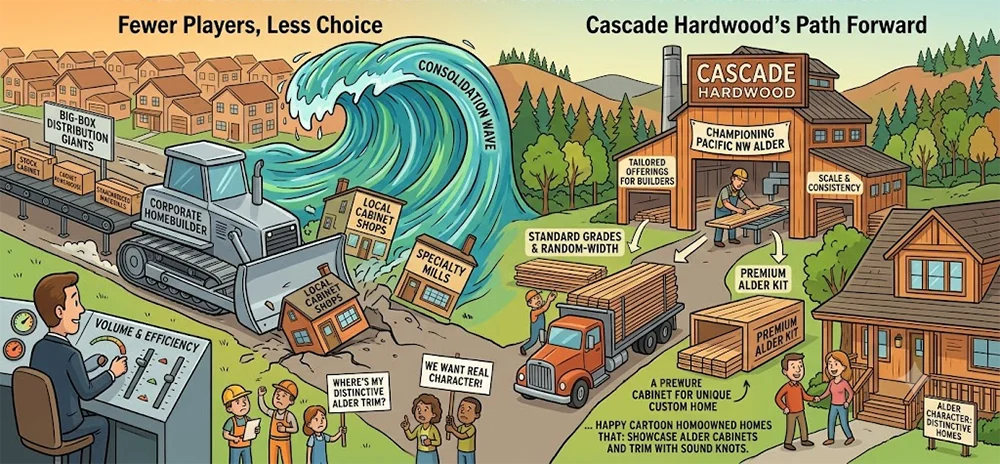
Fewer Players, Less Choice
These moves concentrate power. Builders gain scale and supply chain efficiency, but the market risks more homogenized product lines. Specialty Alder trim, featuring sound knots, natural variations, and custom profiles that elevate a home, can get squeezed when volume-driven suppliers prioritize standardized offerings. Smaller mills and specialty manufacturers face growing pressure, potentially limiting the unique character Alder brings to kitchens, doors, and windows.
Distribution consolidation tells a similar story. Home Depot’s SRS and GMS acquisitions (building on its massive 2024 SRS purchase) and Lowe’s buys of Foundation Building Materials and Artisan Design Group have armed the big boxes with vast pro-focused networks for drywall, doors, hardware, and interiors. QXO’s Beacon Roofing rollout adds yet another layer of consolidated distribution. These giants now control huge swaths of product flow to builders and remodelers.
Big-Box Demands and the Future of Specialty Trim
As home centers deepen relationships with large consolidated builder yards, they demand reliable access to specialty moulding, doors, and windows. Traditional small cabinet and trim shops, long nimble with local Alder sourcing, must evolve or consolidate into larger moulding, door, and window companies capable of meeting strict vendor standards for volume, consistency, and just-in-time delivery to Lowe’s, Home Depot, Menards, and the major pro-focused yards.
This industry shift hurts companies like Cascade that have thrived by supplying established hardwood distribution channels that feed small- and medium-sized cabinet, molding, and door shops. It underscores a clear trend: sawmills must gain greater scale and broaden their product mix to serve these larger manufacturers directly. We will need to develop more tailored offerings that specifically meet their needs, rather than relying primarily on standard grades and random-width products.
We are watching closely as these giants prepare for the next housing upcycle. The significant capital being deployed across these acquisitions highlights a marketplace positioning itself for an expected upturn. For manufacturers, dealers, and builders who prize real hardwood character, the message is clear: the market is changing. The ability to supply what consumers want, at scale and with consistency, will be essential in the coming years. At Cascade, we remain committed to supplying the Alder that turns houses into distinctive homes, one sound knot, one beautiful board at a time.

